My Website

Showing posts with label contraception. Show all posts

Friday, 8 March 2024

IWD: A Centenary to Celebrate in 2024, and an anniversary


There have been various mentions that this year is the centenary of the first - if short-lived - Labour Government in the UK. Its coming to power (however limited that power was in practice) was greeted by the growing birth control movement of the period as a suitable opportunity to press for permitting advice to be given in local authority maternity clinics under the auspices of Public Health Departments. This had already been an aim of the movement - clinics had been set up to meet existing need but were few and far between, and were intended to provide a model for public provision.

Early in 1924 the Ministry of  Health published the report on Maternal Mortality by Dr Janet Campbell, Senior Medical Officer for Maternity and Child Welfare. It revealed shocking levels of annual death in childbirth and widespread induced abortion; and that the risks were greater the larger the family. However, among the suggested remedies, birth control was not mentioned.

On 9 May 1924 there was a substantial deputation to the new Minister of Health, John Wheatley, by a group including H. G. Wells, Dora Russell, doctors, Labour MPs, and members of the Labour and birth control movements, to ask that 'welfare centres shall be permitted to give birth control information to such mothers as may desire it'. The focus was on the lives and well-being of working-class women. There was an assumption that better-off women would be able to obtain contraceptive advice from their private medical practitioners (there is a good deal of evidence, however, see my Hidden Anxieties, that the vast majority of doctors were ill-informed on the subject even when they were willing to talk about it).

Wheatley refused to introduce so controversial a measure involving public funds without express Parliamentary direction; arguing that religious feelings were involved and that there was no public mandate. A petition with six thousand signatures demanding an end to the Ministry's opposition to birth control instruction in welfare centres was rejected, but when submitted to the National Conference of Labour Women on 14 May, they refused 'to accept a a further shelving and temporising resolution of its executive' and voted in its favour by an overwhelming 1000 to 8.

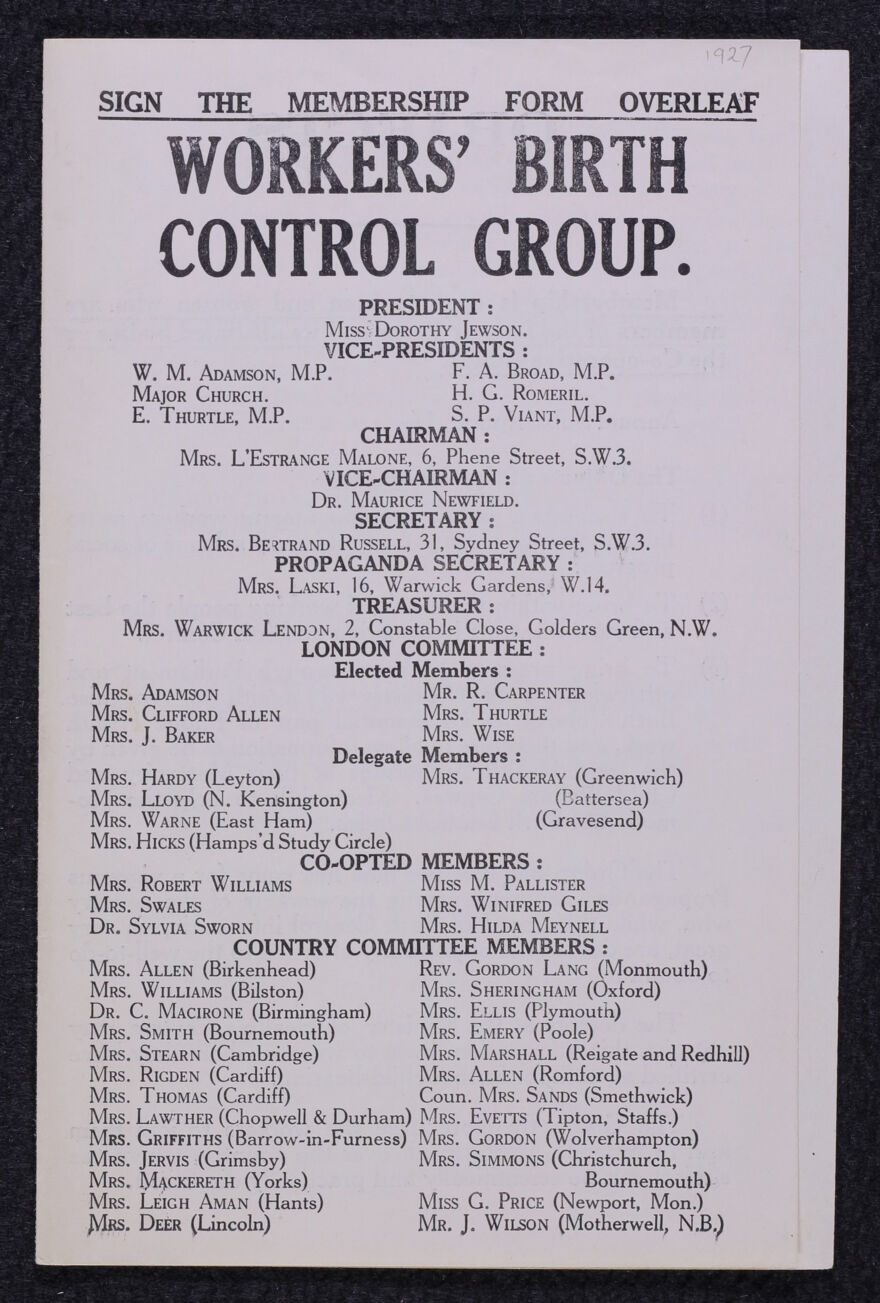
As a result, the Workers' Birth Control Group, which had already been in the planning process, was set up. Unlike the other organisations at the time, it was not establishing clinics, but activitating public opinion, and lobbying local and central government authorities for the provision of advice in publicly funded centres. For tactical reasons, it positioned itself as representing 'working mothers', and its public face was to consist of (married) 'men and women who had known the responsibility of parenthood'. An exception was made for Dorothy Jewson, MP, one of their major Parliamentary supporters; however, although Stella Browne was very much part of the group and tirelessly addressing meetings all over the country, she was not publicly associated with it. (Her open support for the legalisation of abortion was felt to be inexpedient at the particular political moment.)

In 1930, following the passage of a wide-reaching Local Government Act by the Labour Government in 1929, the Ministry of Health quietly conceded a Memorandum 153/MCW on the giving of birth control advice in local authority clinics to women whose lives were endangered by further pregnancy. At first this was issued only to Medical Officers of Health who specifically enquired about the position, but was eventually leaked in Birth Control News by Marie Stopes and disseminated by interested parties including the WBCG.

The WBCG decided that its original intention had been achieved, and dissolved itself. Several of its leading members joined Stella Browne in the struggle for abortion law reform.

However, it was to be a long time before birth control was fully accepted as part of health care. It was not integrated into the National Health Service in 1948 and the terms under which it was provided remained those formulated in the 1930s by Ministry of Health circulars 153/MCW and 1408 of 1934 (which extended the grounds upon which advice might be given). It was left in the hands of the Family Planning Association (previously the National Birth Control Association) or the discretion of individual doctors, and not included in the curriculum of medical schools. This entire process pretty much follows the general model I laid out in my 2010 article in Socialist History 36: '"No sex, please, we'e socialists": the British Labour Party closes its eyes and thinks of the electorate'.

Contraception was finally incorporated into the NHS under the NHS Reorganisation Act 1973 - free family planning services, and supplies subject to a prescription charge. In 1974 Labour returned to power and Barbara Castle, as Secretary of State for Social Services, announced the removal of the charge, irrespective of age or marital status (as had been the situation in many areas following the permissive 1967 Edwin Brook Act). So, a 50th anniversary to celebrate as well.

Images from the Workers' Birth Control Group leaflet from the relevant file in the Family Planning Association archive in the Wellcome Library, SA/FPA/A/13/95A


Monday, 16 January 2023

Paradoxes and contradictions among early twentieth-century birth control activists

 I was extremely gratified last week to see the updated Edinburgh University Press webpage for the forthcoming volume of essays, Naomi Mitchison: A Writer in Time, edited by James Purdon, which has this absolutely gorgeous cover:

main product photoNaomi Mitchison

My essay is 'Send in the Clones?: Naomi Mitchison and the Politics of Reproduction and Motherhood'.

In this there was so much to address about Mitchison's own involvement with ideas on these subjects over her long life, in her activism, non-fiction writing, and in both realist and science fiction, that I did not have space to address her position as one of several leading figures in the interwar birth control movement who found themselves in a somewhat parodoxical and rather contradictory position.

When women in the 1920s began speaking out about the necessity for birth control and setting up clinics, this was taken in itself as a sign of immorality. The worthy founders of the Manchester, Salford and District Mothers' Clinic, were not only decried from the local Catholic pulpit as 'attempting to introduce unnatural vices' but 'the kind of idle women who visit matinees and sit with cigarettes between their painted lips'*: a very misleading characterisation of Mary Stocks and Charis Frankenberg (discussed in Mo Moulton's The Mutual Admiration Society (2019)), who probably saw themselves as rather dowdy social workers.

In order to avoid the associations with immorality and accusations of promoting vice and promiscuity, the birth control movement leaned, with reason, on the figure of the overburdened multiparous married women and the gains for maternal, and also infant, welfare, to be accrued through fewer, better-spaced, pregnancies. The Workers' Birth Control Group, set up by women in the Labour Party in 1924 to lobby for advice as part of publicly funded welfare services, presented itself as representing working mothers, and therefore, 'control of its policy was to be in the hands of men and women who had known the responsibility of parenthood' (apart from Dorothy Jewson, MP, as there were no married Labour women MPs at the time).** This occluded the contributions to their activities of the very unmarried and childless Stella Browne.

The public image of the birth control movement, therefore, was heavily invested in rhetorics of conventional marriage and parenthood, even if there was also a commitment to new egalitarian models of these relationships.

However, a significant number of the leading figures in the movement, including Mitchison, saw birth control and women's reproductive agency as part of a wider vision of transformed relationships, not merely on the theoretical level, but in practice. Mitchison, like Helena Wright, Margery Spring-Rice, Margaret Pyke, Dora Russell and Joan Malleson, herself lived a life of unconventional relationships and evolving new moralities (these did not always work out well, as the disastrous end of the marriage of Dora and Bertrand Russell demonstrated). Mitchison also revealed, in an oral history interview late in life, that although the birth control movement was careful to dissociate itself from abortion, nonetheless at the North Kensington Women's Welfare Centre, where she had been a volunteer, they all knew people who would perform abortions and helped out women in desperate trouble.***

So there was a careful negotiation going on over public-facing presentation and those more private beliefs and behaviour, which might possibly have been expressed in certain sympathetic niche venues.

There was also rather careful negotiation going on with the Eugenics Society. On the whole, the birth control movement was much more interested in improving the lot of actual women in the present and their immediate offspring, than improving the quality of generations yet to come. Some activists had more, and some a good deal less, sympathy with the concept of eugenics, and work on individual clinics has indicated that this varied a lot from clinic to clinic, but that eugenic considerations very seldom had any bearing on actual practice.

[Later thought added] Women birth control activists might also have felt somewhat leery of a body which saw them (and educated white middle-class women generally) as a eugenically desirable demographic whose primary duty ought to be breeding for The Nation. Marie Stopes herself had no truck with that line and voiced forceful objections in Radiant Motherhood. Mitchison, it must be said, was very unusual in this cohort with her seven children: but also (this is discussed in my essay forthcoming in the book!) expressed strong political cavils to C. P. Blacker of the Eugenics Society on the basis of her left-wing convictions.

However, the Eugenics Society had money, and the birth control movement, like most organisations primarily founded and run by women, did not. It lacked the resources of society charity available to the much more respectable National Birthday Trust Fund aimed at improving conditions of childbirth. Because birth control was still regarded rather dubiously even after 1930 when the Ministry of Health had conceded that advice might be given in local authority maternal welfare clinics, and the Lambeth Conference had conceded that it might have a licit place in Christian marriage, a lot of possibilities for fund-raising were not accessible. Mitchison, in her novel We Have Been Warned (1934), has the clinic in 'Sallington' scraping by on the proceeds of jumble sales and amateur dramatic performances. 

A wealthy organisation prepared to put up the money for among other things, research into improvements in contraception was a great temptation. Especially when another tempter was the commercial sector - Jess Borge in Protective Practices has shown how the London Rubber Company was extremely eager to make use of the National Birth Control Association/Family Planning Association for its own ends (the archives indicate that they were far from unique in this respect). Given the very longstanding stigmatisation of birth control propagandists as shills for the rubbergoods and abortifacient industry, the movement had to be extremely cautious about any commercial tie-in.

So, really, the birth control movement between the wars, and indeed, well into the 1960s, was engaged in a very delicate balancing act among paradoxical positions and living with contradictions.

*Mary Stocks, My Commonplace Book (1970), p 161, cited in Audrey Leathard, The Fight for Family Planning (1980), p. 32.

**Workers Birth Control Group files in the Dora Russell papers at the International Institute of Social History, Amsterdam, nos 402 and 403.

***Transcript of interview with Naomi Mitchison by Barbara Evans, 1982, for biography of Dr Helena Wright: Papers of Philip Rainsford Evans and Barbara Evans in the Wellcome Library, PP/PRE/J.1/24


Wednesday, 13 July 2022

Collector's item - very rare, something for the private cupboard, sir?

Currently in the process of looking through some boxes of my own archives, going back some considerable while, and coming across various ephemera and memorabilia that colleagues and friends passed on to me as possibly falling within my sphere of interest. One of which was the photocopy of a page from a catalogue of a sale at Christie's in the summer of 1992, 'The Property of Maxwell Business Communications Ltd' - this included various items of medical/pharmaceutical historical interest, so I can see why my colleague had it.

One item was A rare male contraceptive device, of animal membrane, with printed satirical scene, inscription 'Voila mon choix', and thread and silk tie, French, early 19th century - 7in long. (The satirical scene consists of a nun, two monks, and a bishop, all flashing one another.)


The Times Diary, 10 June 1992, reported that 'the dubious honour of auctioning the world's most collectible condom falls to Christie's next month.... expected to to fetch up to £800'. In fact, it finally went for £3300, to an art dealer purchasing on behalf of a Swedish client who was said to be opening an erotica and pornography museum (Aberdeen Press and Journal, 3 July 1992). This possibly remains the record amount paid for a historical condom.

Digging about to find out any more details on this, I discovered that Christie's did a certain amount of business in antique johnnies: in November the same years the Associated Press reported 'Five 19th century condoms have been sold for more than $12,000 in an auction at Christies' (one said to have been illustrated). A 19th-century French reusable condom, 8 1/2 in long, made from animal membrane with a yellow silk pull-string and maker's envelope inscribed 'moisten before using', was auctioned in 1993 and  two 19th-century condoms with blue silk drawstrings in 1995. Three C18th sheepgut condoms were sold in 2000; and one in 2001, illustrated with a sketch of a sexual encounter.

As historical items, the thought arises that these items must have very considerable conservation and storage requirements.

The other thought that arises is, did illustrating a condom affect its efficacy? What were the health and safety implications in use of the substances used to create the image? Or was an illustrated condom merely a novelty item not intended for actual use?

Tuesday, 18 November 2014

Attack of the sex cliches and national stereotypes

There is a fairly lengthy piece in today's Guardian on the about-to-open Institute of Sexology exhibition at Wellcome Collection (I may have given some advice on specific aspects, but I was not involved in curating this, by the way). It doesn't entirely manage to escape a number of dodgy cliches and generalisations, in particular the one about Those Brits In The Past, so repressed.

So, not only do we get the idea that the nation of Havelock Ellis, Marie Stopes, a host of other sex reformers and educators, and pioneering organisations for birth control, abortion law reform, and marriage guidance, was locked into a 'saucy postcard view of sex': which presumably came after, rather than running in parallel with, that other cliche, 'hooked on cold showers and the pursuit of empire' (is there nothing in the exhibition on Sir Richard Burton, we ask ourselves? - pursing empire perhaps but not about the cold showers).

We also have the O Les Francais, so much more relaxed and sorted about L'Amour than les rosbifs of Olde Angleterre: 
the curators make a little joke about our embarrassment when it comes to sex by juxtaposing a 19th-century French booklet praising “Les charmes de la masturbation” with an English publication, The Secret Companion, in which a gentleman is shown lying exhausted on a chaise longue in a section called “On Onanism as a cause of sexual debility”.
The Great Masturbation Panic was Europe (and North America)-wide - if kicked off by the early C18th quack pamphlet Onania it was given serious credibility by the (Swiss) physician Tissot and fears of self-abuse were disseminated every more widely over the course of the C19th, with the dread disease of spermatorrhoea being more or less invented by the French doctor Lallemand
Early C19th French anti-masturbation corset

While it is entirely probable that in the corpus of C19th British smutty literature there may be found some text on 'The Joys of Frigging' or similar.

Indeed, while Marie Stopes was hymning the benefits of contraception as an essential adjunct to married love, the French government, beset by longstanding fears of population decline, actually made it illegal in 1920, and idealistic Malthusian anarchists were imprisoned for promoting birth control.

There's also the very common simplistic notion of who was liberal and who conservative. Krafft-Ebing may not look like a radical, and he wasn't, but he was a supporter of the campaign for the repeal of Paragraph 175, the German penal law on homosexuality, initiated by Magnus Hirchfeld.

It does, however, manage to eschew some of the usual suspects.

Monday, 6 October 2014

Twitter is a limited forum for discussing 1920s contraception

Further to an exchange on Twitter apropos of (didn't see this, only reported) instance in Downtown Abbey of an unmarried upper-class woman getting herself fixed up with contraception before having a fling. Well, not entirely improbable, but I really don't think she would have been sending her maid (even if she trusted her implicitly not to blackmail her further down the line) to procure the necessary. 

The most reliable form of contraception for women being advocated by e.g. Marie Stopes, and indeed the rest of the UK birth control movement, was the female occlusive rubber cup, and while there were controversies between Stopes's pet high-dome cervical cap and the Dutch cap (diaphragm) that other clinics thought women found easier to fit, it still had to be fitted by a trained nurse or doctor and this was hardly something that a maid could undergo on her mistress's behalf. What the lady in question needed was one of the discreet Harley Street specialists unconstrained by the requirements of the various voluntary clinics to ascertain that all their clients were respectably married. There would, however, be practicality issues around fitting a woman who did not have former sexual experience.

There were other possibilities: W J Rendell's 'The Wife's Friend' quinine pessaries were widely advertised (though without ever explicitly stating what they were for and why they were the wife's friend) in the most reputable women's magazines. However, this is an under-researched (and possibly impossible to research) area of contraceptive practice - the oral histories studied by Kate Fisher in Birth Control, Sex, and Marriage in Britain 1918-1960 and by her and Simon Szreter in Sex before the Sexual Revolution are silent on the topic. However, there is evidence that this was a profitable line, and Rendells were incensed when the National Birth Control Association (later the Family Planning Association) found them not meeting the standards of efficacy and safety necessary for inclusion on their Approved List of contraceptives, pointing out  that they were widely used by numerous (they claimed) entirely satisfied customers (documented in the FPA archives in the Wellcome Library). Quinine, however, is only weakly spermicidal, although the greasy medium used as a carrier did have some effect in slowing sperm motility. But anyhow, these would not have been a particularly reliable expedient.

The really sophisticated cosmopolitan woman might hear about and resort to one of the early forms of intrauterine devices that had been around since the early 1900s, principally the Grafenburg ring, named after its deviser. There was, allegedly, only one doctor (and to no-one who knows anything about these issues surprise, it was Norman Haire) in England who would fit them, and he charged the kind of rate that that commanded, to the extent that at least one woman (the bohemian writer Ethel Mannin, as stated in her correspondence with Douglas Goldring) found it slightly less expensive to travel to Germany and be fitted by Grafenburg himself. Mannin was a great advocate for this method even while conceding that the process of fitting it was the reverse of fun and might even require local anaesthesia.

I find it hard to suppose that the maid's errand would have been to purchase condoms to be discreetly handed over to the partner at an intimate moment. This does not seem a likely scenario for the period.

Wednesday, 4 December 2013

Possibly I am in unduly pedantic mood

Over the past few hours on Twitter I have irked by some simplistic or unthought-through invocations of history.

Just because something has not happened before during one particular (youngish) person's lifetime, doesn't make it a unique phenomenon in history. It is one that can probably even be discernable with other people's living memory (what about the 'New Poor' between the wars or the Great Depression?)

The 1890s/1910s were not a period of uncomplicated British Imperialistic confidence and triumphalism.

Just because a method of contraception exists, doesn't mean that everybody, everywhere, will have access to it, particularly if it's a pharmaceutical product, which will a) be subject to national or regional regulatory licensing systems as to whether it may be prescribed b) is under the control of the medical profession.

Saturday, 27 July 2013

A brief taste of the ICHSTM in Manchester

The International Congress of the History of Science, Technology and Medicine took place in Manchester this week and is still going on. While I didn't have the time - or the stamina! - to attend the whole week-long event, I did get in a very enjoyable day and a half of participation.

I travelled up on Tuesday afternoon, had a preliminary meeting with the other members of the two-panel symposium The science of man? Bounds of knowledge in the twentieth century within which I was presenting my thoughts on Naomi Mitchison engaging with the issues around reproduction and breeding which had been so salient in her own life, and in the circles in which she moved, in her late-life move into science fiction. I then attended the Civic Reception in Manchester Town Hall, a neo-Gothic monument to Victorian municipal pride: very crowded, rather hot, and the acoustics/PA system not perhaps all they could have been for the speeches, but I managed to spot, and chat with, some people I knew.

The next morning I popped into 'Governing minds and bodies with the human sciences' in order to catch Alice White's fascinating paper on Constructing consensus: human relations and the War Office Selection Boards in World War II but then panel-hopped into Expanding women’s sphere: knowledge and the re-definition of women’s work in the twentieth century and stayed with this for the following session, in which I found Rosemary Wall's paper on British nurses in the field of tropical medicine of particular interest.

The 'Science of Man?' symposium on Wednesday afternoon went very well, I thought (kudos to Graham Baker for organising this) and I thought raised issues about complexity, muddle, and definitions that recurred in the following morning's papers. Sometimes looking back we draw lines and create categories that were not there, or at least not taken into account, by the people there in the past moment. And thinking about Graham's paper on Julian Huxley, the useful interrogation of the mainline/reform eugenics dichotomy suggested to me that this (like Old/New Feminism in the 1920s) has perhaps outworn its usefulness.

There was an excellent reception in the Fossil Gallery at the Manchester Museum to launch WISRNet - I think sipping fizzy wine (and eating delicious canapes) under a tyrannosaurus rex skeleton known as Stan adds tone to an event, even before the splendid inaugural speech by Ludmilla Jordanova.

On Thursday morning I made a special effort to get up in time to get checked out my hotel and to the conference venue to catch the first session of the symposium From patronage to biotech: new perspectives on medicine and commerce. Given my own research interests, I was particularly excited by Claire L Jones' work on the supply and marketing of contraceptives in Britain in the late C19th-earlyC20th, as I have long felt that understanding of the industry and its activities has been a major lacuna in the history of birth control. Even if artificial contraception played less of a part than previously thought in bringing about population decline, enough people must have been using it to make manufacture and distribution a profitable, if marginalised and stigmatised, commercial proposition. All three papers were looking at forms of health activity within the home: I am interested to see where James Stark's work on the Overbeck Rejuvenator goes!

I then ventured into the Science as Public Culture revisited symposium session on media, which again, was indicating that narratives of science have tended to impose a clear but sometimes simplistic picture of what was actually happening. I did perhaps want to suggest, in response to Katherine Pandora's lovely paper, that there are some instances of the laboratory becoming an intimate and perhaps quasi-familial space rather than an austere location for the solitary scientist (e.g. Honor Fell at the Strangeways, and her 'tea ceremony' for researchers there). Also, on thinking further about Rebecca Onion's intriguing work on environmentalism in children's picture books, early 1970s, I wonder if this relates to wider issues of children's literature expressing concerns over contemporary problems, but also to the longer tradition of didacticism and purpose in books for children.

All in all, a very stimulating experience which has provided me with a lot to keep thinking about.


Thursday, 20 December 2012

More cross-postery

Sex, religion and royalty: also dairy farming: post on the Wellcome Library blog about Lord Dawson's papers and his involvement in the moral panic of 1932 about condom vending machines. With pictures! 


A Different Kind of Nurse: Wellcome Library blog post about a notebook of lecture notes kept by a member of the Voluntary Aid Detachment, some time around World War I


And this isn't one of mine, but I wish it was: one of my colleagues connects Library holdings of the Krafft-Ebing papers and Sacher-Masoch's correspondence to The Velvet Underground: Shiny shiny, shiny boots of leather, managing to get sex, drugs, and rock-and-roll into a single post. Hats off!


I haven't yet managed to write up as a blog post my impressions of a newly catalogued manuscript recipe book from the early C19th century that could have belonged to the Starkadders of Cold Comfort Farm, but this may yet appear.


 On a rather different note, my annual round-up of reading highlights and other cultural pleasures of the year appeared on Ambling Along the Aqueduct. 


Wednesday, 1 August 2012

Interesting forthcoming conference

Non-Reproduction: Politics, Ethics, Aesthetics
1 February 2013
Birkbeck College, University of London

Cultural anxieties concerning biological reproduction often pivot around the notion of the non-reproductive body, in which intersecting fears about class, race, sexuality, gender and disability are encoded. Media discussions of abortion rates, teenage use of contraception, and gay marriage all register the perceived threat of sex without procreation. In a broader sense, the imperative to safeguard the future by ‘thinking of the children’ is powerful ideological currency, animating activists on both the left and the right.

A number of writers have responded to this tendency by considering the aesthetics and ethics of the non-reproductive. Recent work in cultural studies has emphasised the radical potential of the subject that refuses reproduction. In Unmarked: The Politics of Performance (1993), Peggy Phelan locates the radicalism of feminist performance art in its status as ‘representation without reproduction’. More recently, Lee Edelman’s No Future: Queer Theory and the Death Drive (2004) argues that resisting heternormativity entails refusing to participate in ‘the cult of the child’. According to Judith Halberstam (2008), Edelman’s work is part of an ‘anti-social turn’ in queer studies which ‘always lines up against women, domesticity and reproduction’.

Inspired by Halberstam’s intervention, this one-day interdisciplinary humanities symposium invites critical perspectives on the idea of non-reproduction. How is the assumption that the non-reproductive necessarily resists the dominant order undermined by right-wing strategies that seek to limit reproduction, such as forced sterilisation, 'population bomb' rhetoric, discriminatory welfare policies or the stigmatisation of single parents. Is it helpful to draw a conceptual opposition between the reproductive and the non-reproductive? Are there alternatives to this framework? What are the implications of ‘non-reproduction’ and anti-futurity for approaches to the archive and the preservation of cultural and social documents?

Contributions are welcome from graduate students and early career researchers across the arts and humanities, as well as thinkers, activists, writers and artists working outside academia.

Topics could include, but are not limited to:

• pro-choice politics versus reproductive justice
• global warming and population discourse
• Refusing parenthood in art and literature
• Infertility and IVF
• Contraception and abortion politics
• Queer theory and the family
• Gay marriage in the media
• Feminism and maternity
• Museums and heritage
• Textual repetition and reproduction
• Discourses about the child (e.g. the child as commodity)
• The disabled child and controversial sterilization procedures (eg. The Ashley Treatment)
• The politics of non-reproduction in an age of accumulation
• copyright law
• Gustav Metzger and destruction in art
• Derrida on the archive
• Performance theory

Abstracts of 250-300 words for 20-minute papers should be sent to non.reproduction@gmail.com by Monday 1 October.

Organizing Committee:

Fran Bigman, PhD Researcher, Faculty of English, University of Cambridge

Harriet Cooper, PhD Researcher, Department of English and Humanities, Birkbeck College, University of London

Sophie Jones, PhD Researcher, Department of English and Humanities, Birkbeck College, University of London

Friday, 4 May 2012

Stephen Brooke, Sexual Politics: Sexuality, Family Planning and the British Left from the 1880s to the Present Day (2011)

I read this book several months ago and in something of a rush, in order to be able to include some of its important insights into the final round of revisions to the new edition of Sex, Gender and Social Change, and have been meaning to do a somewhat more extended consideration of it ever since, a project significantly stymied by the arrival of various other commitments and deadlines demanding my time and energy.

This is certainly an extremely useful study. While some of the material in the earlier chapters was fairly familiar from previous work on the birth control and abortion law reform movements, Brooke brings some useful new analyses of the material by placing sexual politics in their long and often conflicted relationship to the more conventional political sphere (a nuanced and detailed working out of some of the issues I briefly delineated in my article in Socialist History, Vol 36, 2010, 'No Sex, Please, We're Socialists': The Labour Party prefers to close its eyes and think of the electorate') . Sexual Politics also provides a particularly valuable account of the rather less explored area of the various shifts taking place in political and social cultures around reproductive control, women, motherhood, and the family from the advent of the NHS to the C21st. Brooke makes some thought-provoking interventions into questions about periodisation and the place of continuities and co-existence of differing paradigms rather than abrupt hiatus and definite changes. The narrative also demonstrates shifts within political culture in response both to activism around sexual issues and to wider social change and new concepts of citizenship and what came to be included within the sphere of political activity.

Sexual Politics additionally constitutes a useful reminder of the tensions and conflicts and different levels of activity over these issues within the Labour Party itself. Although the title invokes 'the Left', the book focuses on the Labour Party, with a nod or two to the Communists, largely at the national level, though with an awareness of the significance of local groups and special interest campaigns. Brooke inscribes the importance of class in both the increasing acceptance of family planning as a licit concern of the left, culminating in the non-controversial permissive National Health Service Amendment (Family Planning) Act of 1967, and in the long reluctance, in spite of such pioneering socialist icons as Edward Carpenter, to consider homosexual law reform. This came about, arguably, more as one element within a smorgasbrod of liberalising reforms which the party, or at least, certain leading powerful figures (Brooke places Roy Jenkins as pivotal), saw as part of its agenda in the 1960s. Although most of these measures originated as private members' bills, governmental allocation of time for debate and help with drafting played an essential role in getting them through.

It would have been interesting (though this book already covers a great deal of territory) to have incorporated more about those causes described at the World League for Sexual Reform Congress in London in 1929 as the 'planks' in its 'platform': these included marriage reforms such as improved facilities for divorce as well as education for marriage, sex education of the young, and the abolition of censorship. Some of these aims were indeed achieved during the 'liberal moment' of the 1960s. But some were not. Sex education, for example, remains a contested and controversial issue. Some attention to these topics, the penumbra of sexual reform issues, might also have overcome the slight cynical feeling that occasionally arises that homosexuality could possibly have been included to extend the potential audience for the book by broadening its appeal beyond those concerned with reproductive politics (Brooke himself points out in the text that much of the territory of gay politics/left politics and their intersections since the 1967 Act has been ably mapped by Lucy Robinson in Gay Men and the Left). These were also issues which for which there is a narrative trajectory, rather than endless reiterations with little to show. There are indeed useful points of comparison and contrast illuminating the differing interests and agendas within Labour to be gained by taking these particular issues, and the choice undoubtedly pays off as the narrative is taken on to the initiatives of the 2000s.

(Many of the questions and points raised above are dealt with in much fuller detail and with greater nuance in the revised and expanded second edition of Sex, Gender and Social Change in Britain since 1880, now in press.)


Friday, 3 February 2012

Website update: Situating Stopes

I've just added to my website the paper Situating Stopes: or, putting Marie in her proper place that I gave as keynote at the IHR@90 event, The Birth of the Birth Control Clinic, last March. There don't seem to be any plans afoot to publish the proceedings from this conference (and it doesn't seem as though the projected podcasts of contributions have happened), and anyway, much of the material synthesised in my paper was drawn from things I had already written on Stopes and on the interwar birth control and eugenics movements. However, I think it is a useful overview of some of the issues that continue to surround Stopes and make her a persistently controversial figure.

Monday, 17 October 2011

Another exciting workshop on reproduction in Cambridge

I do find it somewhat amusing that this plethora of fascinating events on reproduction-related matters is taking place at the academic institution from which William Empson was dismissed for the possession of contraceptives in 1929.
Interdisciplinary Workshop on Reproduction 7
Friday, 18 November 2011
09:00 - 18:00
Location: CRASSH, 17 Mill Lane, Cambridge
9.00 -9.20 Registration
9.20 -9.30 Welcome and Introductions
9.30 - 10.00 Session 1
Chair: Susan Golombok (CFR)
Karin Ekholm (HPS)
"Why we begin with the hen's egg": investigations of animal generation, 1600-1650
10.00 - 10.30  Peter Jones (King's College)
and
Lea Olsan (University of Louisiana at Monroe)
Charms and amulets for conception and childbirth
10.30 - 11.00 
Sarah Jennings (CFR)
Children's voices: the perspectives of children and young adults with lesbian and gay parents
11.00 - 11.30 Tea/Coffee Break
11.30 - 12.00 Session 2
Chair: Richard Smith (Geography)

Romola Davenport (Geography)
Reproduction in the city: the revolution in infant survival in eighteenth century London
12.00 - 12.30
Anne R Hanley (History)
Venereal conundrums: medical and social knowledge of venereal disease in late-Victorian and Edwardian England
12.30 - 13.00
Salim Al-Gailani (HPS)
Maternal nutrition and the medicalization of pregnancy in late twentieth-century Britain

13.00 - 14.00 Lunch Break
14.00 - 14.30 Session 3
Chair: John Forrester (HPS)

Fran Bigman (English)
The shattered mould: abortion and class in 1930s rhetoric and fiction
14.30 - 15.00 
Jesse Olszynko-Gryn (HPS)
Pregnancy test pills as camouflaged abortifacients in the 1960s
15.00 - 15.30 Tea/Coffee Break
15.30 - 16.00 Session 4
Chair: Nick Hopwood (HPS)

Ramona Braun (HPS)
Endoscopic alternatives for female fertilisation and sterilisation in the 1960s
16.00 - 16.30
Susan Imrie (CFR)
An investigation into the impact of surrogacy on the children of surrogate mothers


16.30 Closing remarks

Saturday, 30 July 2011

Catching up on journal literature and chapters XIII

More from Lucy Delap, Ben Griffin, Abigail Wills, The Politics of Domestic Authority in Britain since 1800 (Basingstoke, Palgrave Macmillan, 2009),  
Megan Doolittle, 'Fatherhood and Family Shame: Masculinity, Welfare and the Workhouse in late Nineteenth-Century England' pp 84-108, which is really useful on the instability of working-class male identity and authority within the family, possibly increasing with developing state/voluntary  interventions in late C19th. The humiliation of the rituals around entering the workhouse - in fact this was fairly small % of population but may have been effectively deterrent? (wonder if vaccination resistance fits in here)
Deborah Thom, '"Beating children is wrong": Domestic Life, Psychological Thinking and the Permissive Turn' pp 261-283 - mentions that Susan Isaacs and Mary Chadwick refer to potential dangerous sexual arousal of spanking as punishment.

Lesley Hoggart, 'The campaign for birth control in Britain in the 1920s', in Anne Digby and John Stewart, Gender, Health and Welfare (1996), which is largely about the Workers' Birth Control Group and about which I was just a shade iffy - yes, there was a maternalist and socialist slant to their work and it wasn't a feminist campaign by the standards of late C20th ideas of feminist politics of reproduction perhaps, but my own feeling is that there was a certain amount of finding strategic rhetorics, e.g. maternal health, by which to promote b-c (though I think this might also read interestingly side by side with the Brooke article about Dora Russell and the modern female body). I certainly wouldn't concur that the 1930 Ministry of Health circular was what the WBCG wanted, because its provisions were so minimal and restrictive. However, it was an important symbolic victory.

Laura Tabili, '"Women of a Very Low Type": Crossing Racial Boundaries in Imperial Britain', in Laura Frader and Sonya Rose (eds), Gender and Class in Modern Europe (1996, pp. 165-190: a classic and important article about perceptions of the 'Black' (actually extremely diverse groups of Africans, Asians, etc) communities in early C20th Britain and the stigmatisation women who associated with them. They were mostly concentrated around ports and docklands - which brings in a whole lot of existing class and gender prejudices associated with those areas. Notes the invisiblity of Black/mixed race women in the debates which are all about 'Black' men and 'White' women. Indicates that prejudices were not monolithic, and within the actual communities these families were accepted.

Pamela Dale and Kate Fisher. 'Contrasting Municipal Responses to the Provision of Birth Control Services in Halifax and Exeter before 1948', Social History of Medicine, 23, 2010, pp 567-585. More on the important local dimension of the introduction of birth control services and the interests who were behind the clinic - in Exeter it was much more officially sponsored and also had significant support from local philanthropic (eugenically-inclined) ladies, but was not as much of a success as it might have been at pulling in the punters. In Halifax the clinic was very much out of the loop of power and influence and networks but was arguably more successful with its client base, to which it was very responsive (i.e. quite flexible and open to people's needs rather than imposing a model). 
This is probably not entirely connected to this, but I have been wondering (thinking about the extent to which the work on clinics, and the oral history work, indicates relative lack of take-up of the cap) about the other female methods like sponges and soluble pessaries which don't seem to be in this debate at all - it's either male methods like withdrawal or condoms, or it's the complicated and disliked cap.

Roger Davidson & Gayle Davis, 'Sexuality and the State: the Campaign for Scottish Homosexual Law Reform, 1967–80' , Contemporary British History,  2006 20:4, 533-558 - asks whether the final outcome of the campaign was anything more than a rather weak symbolic victory in the face of continuing Scottish homophobia and continuing refusal to consider that it was a problem - i.e. takes the story on from their Wolfenden article

Katherine Holden, 'Imaginary Widows: Spinsters, Marriage, and the ''Lost Generation'' in Britain after the Great War', Journal of Family History 2005 30: 388. Really good piece on the specific way that unmarried women were perceived after the Great War and the way that there was a perception (correct or not) that it was about them having been, as it were, pre-emptively widowed by the losses during the War and how that affected attitudes and policies. Has all the nuance and complexity of The Shadow of Marriage.

Women's History Review Special Issue 'Lone Mothers', Vol 20, 2011:
Pat Thane, 'Unmarried motherhood in twentieth-century England' - draws on her work on the National Council for the Unmarried Mother and Her Child and really interesting on a body which took up this very unpopular cause and agitated around it. How relatively few unmarried mothers were bringing up their children alone - might be in stable cohabitation but unable to marry, or child was absorbed into family - changes over time esp after WWII - issues around adoption, etc.
Ginger Frost, '"Revolting to Humanity": oversights, limitations and complications of the English Legitimacy Act of 1926' - a badly devised piece of legislation. Note that the fact that cases for legitimation were heard in open court put a lot of people off (as did the complicated bureaucracy). Easier for parent/s to adopt their own illegitimate children and thus give them legal status.